A Symphony of Life: Professor Lorna Griffitt's Musical Odyssey
Upon entering the university’s music and media office building, a bleak hallway of gray doors, empty walls and muted pastel blue-yellow-white checkered floors, an operatic whinny escapes from the crack under a door. Its piercing register pushes further down the hall where the muffled notes of two dueling pianos, student versus professor, rigorously sound the same melody over and over and over again.
Inside the piano room, more akin to a shoebox with the two baby Steinways lined side by side, shelves cluttered with music books and leafed with loose music sheets hug students in the yellowish lamp light. Professor Lorna Griffit jostles her head and sways to the rhythm of her fingers. Light bounces off the glass frames of the office, a longstanding tradition where photographs of her beloved mentors are carefully nailed to the wall. Arms relaxed, she caresses the piano’s bone white keys.
At the University of California Irvine, Griffit is one of two piano performance professors, but her connection with music extends far beyond the classroom. A musical prodigy from the age of 16, she has dedicated her life to the study and teaching of music with the belief that her musical passion can be a force of good in the world. Outside of her teaching duties, Griffit makes ripples in the musical world, traveling and collaborating with international artists, people of all ages and backgrounds,
“The world needs to experience art of any kind, in doing so you become a better person.
Griffit, 71 has been a piano player and performer for almost 60 years, but only in the last few years of her life has she discovered music for herself. She has mastered what she calls an “aerial view” of music, to play pieces with the bigger picture in mind, technically, audibly and historically.
“Now is the first time in my life I can devote myself to piano.”
As a child Griffit was undisciplined but talented, and “hungry” for anything she could learn. Her first concerts were performed at the houses of her piano teacher, Morine Carkik’s wealthy friends. Carkik instilled discipline at Griffit’s early age by having her walk up and down the four story staircase if she made a technical mistake.
Being a young performer, she says, like many others, has advantages in that it provides this childlike innocence and naivety that made her music loose and her nerves settled. It wasn’t until she studied music theory, music history, chamber music and music analysis that self awareness brought upon performance anxiety.
“Some people can still keep that youthful spirit… [For me] the unknown, live performance, is a little bit like riding a roller coaster, anything can happen.”
Griffit’s teaching style balances a laid back attitude in large classrooms and a stricter discipline one on one. She takes on ten students from every grade and coaches them from their freshman to their senior years of college. When asked to make a list of qualities that make good teachers, passion was placed first.
“It’s the feeling behind what you’re doing, if you don’t have it you shouldn’t be playing music.”
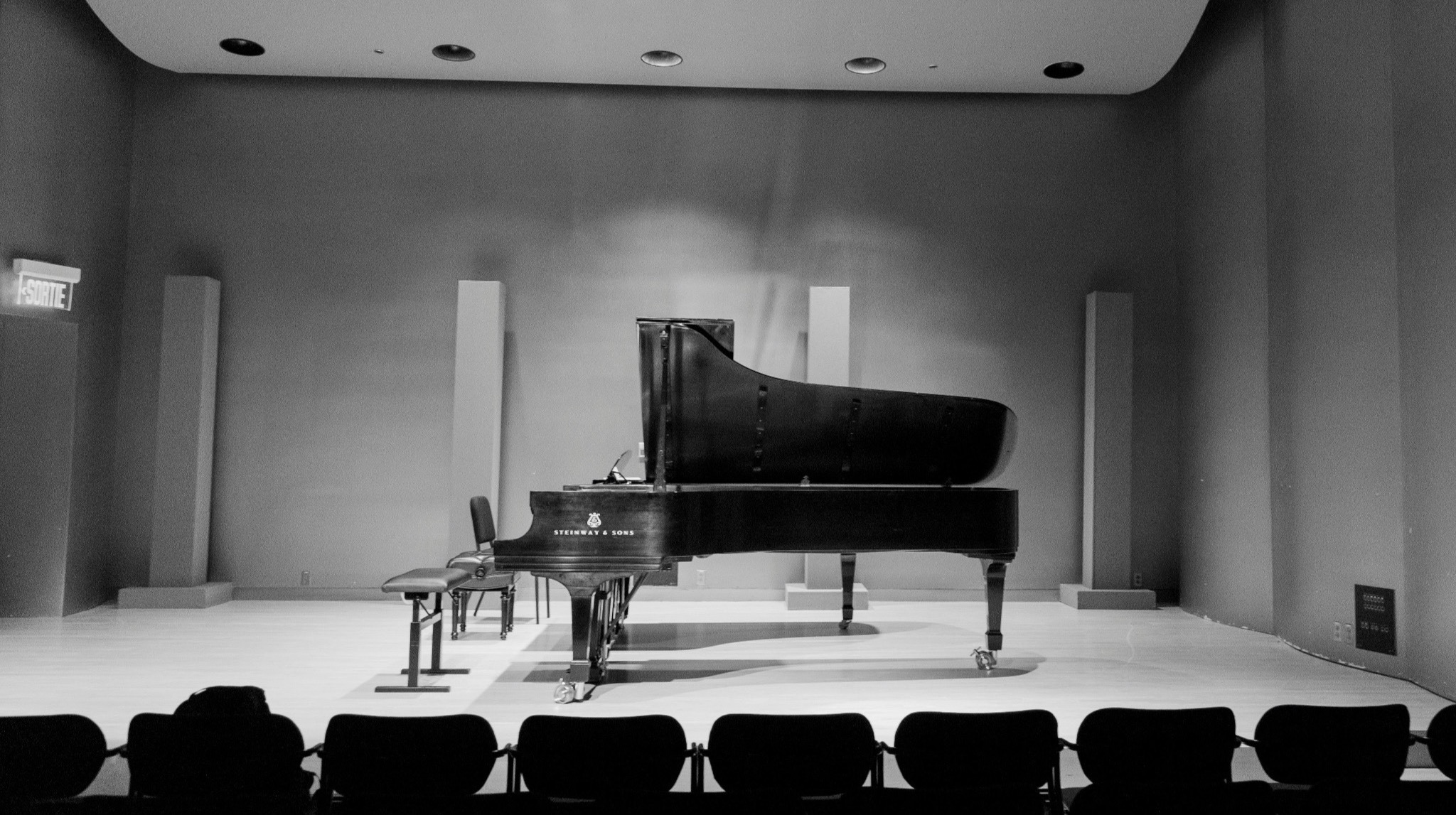
At precisely 8:04 p.m. in the Winifred Smith Hall on UCI’s campus, Lorna Griffit glides into the spotlight from backstage. Her navy gown adorned with sequins dance under the stage lights. The soft ivory bob atop her head enhances the glistening evening star effect of her attire. The audience applauds, but without a word she sits at the piano bench, tucks her hair behind her ears and begins.
Upon first impression she is difficult to read. But quickly it becomes clear that she will let the music speak for her. Tonight she plays…The intimate hall feels as if it is shrinking in size as the audience leans in–mesmerized.
In a playful search for the qualities behind each note, her fingers follow the direction of her eyes with practiced, gripping emotion. Mouth agape she sways and breathes into the movement of her fingers when the music is soft.
Her page turner is small and discreetly dressed in black. They communicate with a nod, and as the page turns, the music becomes increasingly technically challenging. Griffit’s face tightens, lips pursed, as her fingers move more furiously, hands crossing over one another, and the Steinway beams like a centerpiece of straining brass chords, its keys thumping up and down in a flurry. Griffit shrugs and shakes her head in conversation with the music.
The silence is loud as she finishes each sonata, giving people a few short moments to digest the music. Then, she removes her glasses to address the crowd, and a warm smile begins to explain in a few sentences the history of the music, its relationship to the composer, and the emotions the music evoked. Steadily, she ropes the audience deeper into her performance.
The first sonata, she says, gives way to Bach’s feelings of isolation as during this time he had gone almost completely deaf, communicating only by writing in notebooks. The second is a gentle, melodic march, the third feels like longing, and the final, longest and most technically challenging sonata is romantic, full of joy and surprise.
“I always play this piece with great vitality but this one’s not so warm and fuzzy,” she warns before the second half of her performance, and the audience laughs.
Each member of the crowd is tethered to the delightful mood swings radiating from center stage. Some hold their head in their hands, eyes closed as if to focus only on their auditory senses, others appear stern, hand over mouth.
An older woman in a red cardigan, red shoes, ridiculously large glasses frames and a stout velvet top hat, beams, eyes sparkling in an unwavering trance. Griffit’s aura buzzes energetically from the constant drama and tension between her and her piano. Like an actress in a play, she musters the rawest of feelings to convince the audience of their existence and sucks them into a world, a story of themselves in the music.
The performance ends as swiftly as it had begun, and the bravos continue for such a time that she must return to the stage to give a second bow.
The woman in the velvet hat with the beaming smile stands alone, in awe, applauding vigorously with the rest of the audience. As the lights come on, a line of multicolored bouquets make the length of the stage as students, friends and fans eagerly await their turn to give congratulations.
Griffitt's musical journey began at a tender age, dancing and singing along to records on the front porch of her Indiana countryside home. “There wasn’t a time when I was not dancing or singing,” she says, recalling that she would run up and down the grassy hills belting opera at the top of her lungs.
This early connection to music laid the foundation for a career that would see her perform as a soloist with the Louisville Orchestra at the age of sixteen, directed by Robert Whitney, where she showcased her talent with Edvard Grieg’s Piano Concerto in A Minor.
Her dedication to the craft led her to Indiana University, where she earned her doctorate with distinction in piano performance, earning the esteemed title of Doctor of Music. Griffitt's musical odyssey has taken her across continents, sharing her artistry with audiences in the United States, Europe, the Middle East, and South America.
Before joining the faculty at UCI in 1993, Griffitt embarked on a career in 1974 at the School of Music at DePauw University, teaching piano and music theory.
Griffitt's summers are marked by invitations to prestigious events such as the Orfeo Music Festival in Vipiteno, Italy, and the Rio International Cello Encounter in Rio de Janeiro. Here, she not only performs but also imparts her wisdom through masterclasses, forging deep and abiding friendships with international artists, transcending language barriers.
As an educator, Griffitt draws inspiration from her mentors, including luminaries like Menahem Pressler and Gyӧrgy Sebők. Her hopes for her students go beyond technical prowess; she desires them to experience their own love and understanding of music, enriching their lives and enabling successful musical careers.
For Griffitt, music is not just a profession but a fundamental part of human existence. "From the beginning of time, music has always been a vital part of human existence. It is one of the most basic human needs. All kinds of music, along with all the arts, touch us and inevitably make us better people," she says.
With a career marked by highlights, from playing Rachmaninoff Paganini Variations with an orchestra to witnessing breakthrough moments in her students, Griffitt remains humble.
"I feel incredibly privileged to be able to live my life trying to find ways of performing and teaching with an ever greater and deeper understanding of the music. I am still trying to improve! It’s the everyday process of practicing that is immensely gratifying."
Post a comment