The Secret of Cuba's Dying Art
Fernando Morales is one of a rare few whose hands hold the secret of a dying craft. Like many before him, he fled oppression under Fidel Castro’s communist regime, and settled in America with little more than his artisanal skills.
Cuba-trained Torcedores are skilled craftsmen who specialize in a centuries old tradition of rolling and crafting cigars by hand. Even in a well-paying, highly-respected trade, Fernando faced a future constrained by tyranny. After moving to the United States in 2008, his business, My Cigar Roller, based out of Miami, Florida, reignited his passion for the craft. In the last 15 years, he has traveled the country working elite corporate and social events, selling high quality cigars and showcasing his artisanal mastery. It is only with years of experience that the best cigar rollers come to learn the secret of the industry as Fernando has.
“In Cuba I had nothing, I had no future. It was suffocating, the regime controls everything…At the time I had two choices: fight [against the government] and go to jail for 20 to 25 years, or leave.”
Fernando’s decision to leave Cuba in 1992 separated him from his craft for 16 years, as he had to support himself by other means before launching his business. But My Cigar Roller has since been up and running for almost as many years, and even at 54, Fernando has no intention of retiring. He is away from Miami on business about half of the weekends every month (and some change) and wouldn’t have it any other way; oftentimes he is accompanied by his wife.
In some ways, his job is very simple: no matter the location or purpose for gathering, Fernando supplies a taste of Cuba. Each event, Fernando has stacks of humidors in tow with an assortment of ready-made cigars and enough material to roll consistently through the duration of the function, demonstrating to customers the process by which they are made. Simultaneously, he guides people to a cigar of their liking, answering their questions, chatting with new faces and watching their reactions as they take their first few puffs.
Torcedores spend their lives chasing an unattainable perfection set by customers’ expectations. Every harvest differs from the last and each batch of cigars is unique. It is difficult to replicate a previous blend and flavor.
“It’s really hard to find consistency in something that is natural. Regardless, people are going to judge you or say, ‘oh it used to be good’.” Sometimes a customer doesn’t like his cigars, “It happens every year…There is no perfection in cigar rolling.”
His company’s tobacco is grown from Cuban seeds by Dominican, Honduran and Nicaraguan growers to make up the filler– the heart of the smoke. The tougher leaves of the binder are shipped from Ecuador. Wrappers arrive from Ecuador and sometimes Mexico, their color signifying to buyers the overall flavor profile of their cigar. Fernando parcels through bulging canvas bags of tobacco, organizing his shipments into current and future reserves; ultimately, he must blend the flavors of each layer just so, to create a high quality product that tastes good every time. A roller’s secret, he reveals, is personal to each Torcedor.
“The secret of the industry is artistic choice, you create something, not a machine. And all your worries, anxieties and personal issues are reflected in your cigar.”
Cigar smoking, rooted in age-old tribal rituals, has evolved into a global phenomenon and a cultural rite of passage, with its origins traced back to native tribes in Central America. Excellent climate and soil, native tobacco seed varieties, and the handcrafting tradition has ingrained the art of cigar making in Cuban culture.
It is why only Cuban rollers with 25 plus years of rolling experience work at My Cigar Roller. They have all learned the trade in their homeland. Fernando pays them to roll cigars in preparation of his events, and for general purchase on his website. When he first began his business, finding rollers was easy. Now many are retired, too old to roll, or deceased.
Many friends in the business also retired after struggling during COVID, unable to recover. As production shut down and tobacco stashes ran dry, Fernando scrambled by rationing his stash and emptying much of his savings to keep his business alive. But even after the detriments of COVID, competition remains fierce.
Fernando says he is “middleground” among the community of cigar rollers, but his services have been recruited for the NFL Super Bowl, the NCAA Final 4, and NASCAR, in addition to other gatherings for some of the largest corporations in America. The process, however, is always the same he says, no matter who his clients are.
“I’m proud of how far I’ve come, I plan the long run and it helped me resist any challenge and endure. But I think part of my success comes from the quality of my product. I don’t sell anything that I wouldn’t smoke, and my clients know that.”
Bald and bronzed by the sun, Fernando is dressed in a traditional Guayabera shirt with a chunky gold watch resting on his left hand. It is difficult to imagine his yellow smoke-stained smile unaccompanied by a cigar in his mouth. As he works, people of all ages and colors linger by his table strewn with cherry and pine wood humidors and bordered by metal trays of cigars in various shapes and hues. He banters with a group of middle-aged men inquiring whether they can film him in action, then he asks if they enjoy living in San Diego. “It’s a lot less humid here than Miami,” says one in a black polo, and the group proceeds to explain that the past week of January had been unseasonably warm.
The humidors lay open on purple satin tablecloths surrounded by signs that say “Henry’s Cigar Bash” and as more hands reach for the leafy indulgence, the room fills with a rich, warm aroma of aged tobacco, a tantalizing symphony of earthy, woody, and sweet scents. One humidor is decorated by a glossy silver oval featuring the words ''Habana'' inscribed beneath four women, one of whom has rays of light emanating from her silhouette. A plate of matches and cigar cutters flank short, dark and stocky Robustos, long and slim Panatelas, and striped, pointed Torpedoes, all stacked neatly on the leftmost side of the table, atop their respective kind.
The room overlooks the coastline, and orange rays of evening light filter through the window accenting the wisps of smoke that are beginning to cloud above a group of heads. Echoes of clinking glasses and buzzing discussion slowly increase in volume.
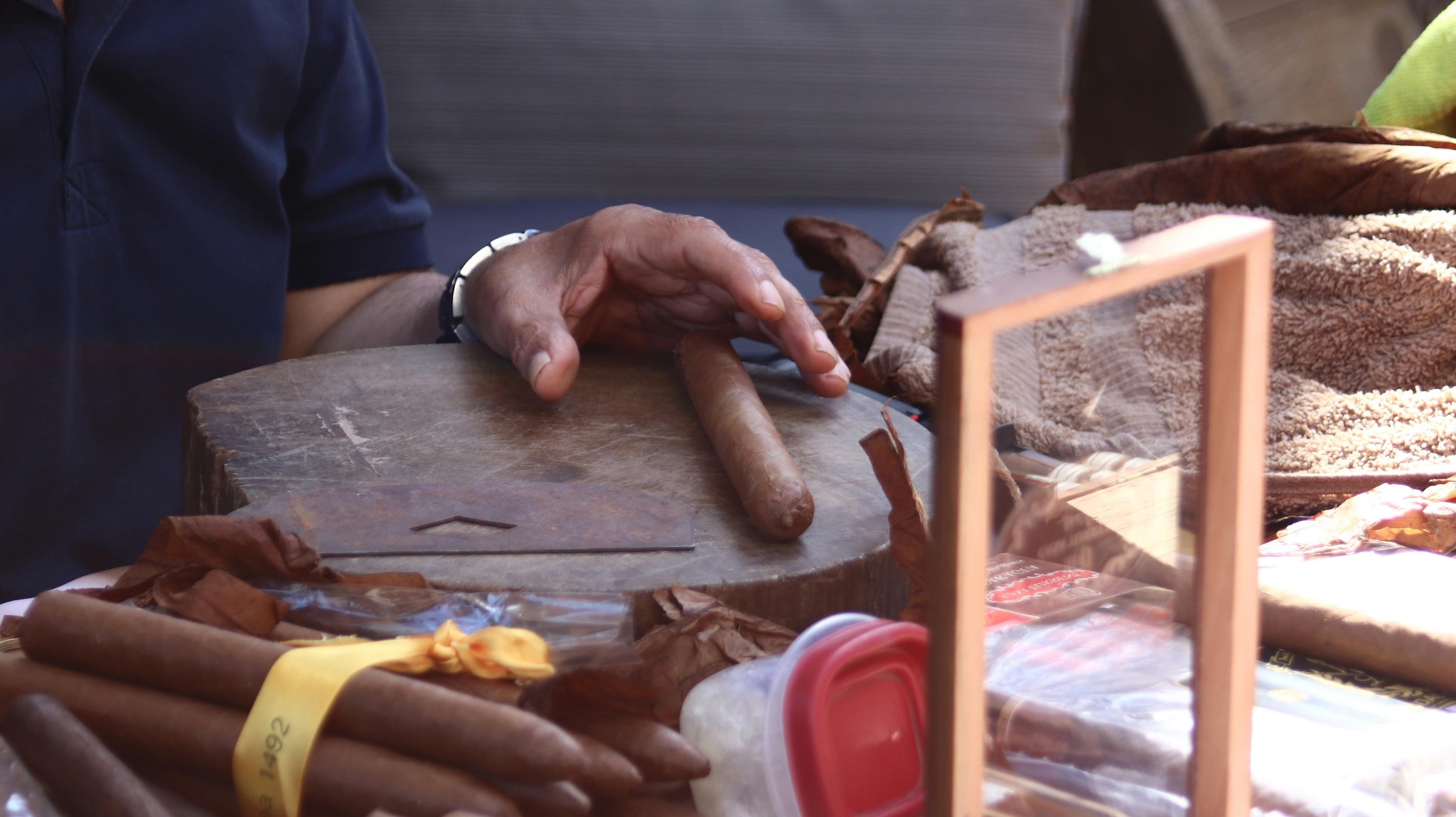
Holding the tobacco wrappers in one hand in shriveled skin-like twists of chocolate brown, Fernando sprays them lightly with water to return them to life. Placing one on a wood board and smoothing the wrinkles with practiced fingertips and slightly overgrown fingernails, he uses his late grandfather’s chaveta, a curved blade to slice the leaf into a less pointed crescent moon shape. In one minute he removes from the cigar mold: a filler of tobacco blend coated by a binder of thick, sticky leaf to hold it in place, and rolls it neatly in the tobacco wrapper, engineering a perfectly cylindrical cigar. Crowding faces of furrowed brows morph into open mouthed wonder, nodding and murmuring their respect.
While Fernando enjoys intimate gatherings where his talents can be on display, nothing compares to Louisville’s Kentucky Derby. His connection to the Derby is cemented in him from childhood.
“I love the Derby. It’s very traditional, very American. Havana had one of Cuba’s biggest race tracks and I never got the chance to see it. [I love] real American food, getting your fingers dirty, people all dressed up–year in and year out you see new people and new faces. It’s when everyone just lets go.”
For the 2019 Kentucky Derby event, he wore a peach suit jacket, a light blue dress shirt and bright, white pants. He and his wife are invited annually to the President’s Balcony where VIPs like Jeff Bezos and Donald Trump have all inclusive access to Fernando’s overflowing cigar table.
“I remember Trump didn’t have any of my cigars, but every one of his secret service guys did, and some of them even took a couple to-go.”
This time, Fernando pays no mind to the personalities, and does not roll for his audience. Instead the focus remains on the race, and hand draped around his wife he absorbs the ambiance, sucking a cigar slowly.
Havana, where Fernando was born and raised, held horse racing at the Oriental Park Racetrack created by a Cuban-American consortium of investors and drew Havana’s high society and horse-racing enthusiasts for events. Less than ten years after Fidel took power in 1959, the racetrack grew silent and desolate, and now bears the ghostly imprints of its racing history. Like much of Fernando’s upbringing, it was marked by the hostile political environment.
“I grew up in the generation where my parents had everything, and we had nothing. As a kid there was a lot of don’t do this don’t do that. When you don’t have anything you have fun with what you do have, and we would make our own toys.”
But, his parents were not immune to struggle. He remembers his mother, a school teacher, coming home one evening and telling him that she was unable to feed her students, having only two eggs in the fridge.
Still, Fernando enjoyed his youth. As a boy he recalls his days filled with vibrant colors and the rhythmic beats of salsa music drifting through the narrow streets. The scent of saltwater and the tropical breeze from the nearby Malecón often greeted him as he navigated his way to school. The city's architecture, a blend of Spanish colonial and Soviet-inspired structures, created a unique urban landscape. The vibrant street life was infused with a sense of community, where neighbors knew each other by name, and families gathered in the evenings for communal activities.
Fernando learned to roll at El Laguito in Havana, Cuba. He was 16 years old and hated it. Every morning he reported there at 9 am for a rigorous 6 month cigar rolling program. Everyone wanted to learn to roll, but Fernando participated because he was not enjoying his high school classes and at his mother’s behest, took a break to learn the cigar trade. His cigar rolling teachers were old and “full of heart”, and when he graduated, he was one of 30% that had succeeded.
After high school, Fernando begrudgingly joined the workforce as a professional Torcedor. Because Torcedores are so well paid in comparison to other jobs, he sat in a stuffy room for hours, turning the tobacco leaves between his fingertips, and paid for each flawless cigar.
Serendipitously, he obtained a Canadian visa at 23 years old, contingent on a marriage between him and a woman who met Fernando while visiting Cuba. He stayed in Canada moving from city to city, working in the hotel industry. Struggle chased Fernando who found little success working his way from the bottom up. Long hours, small paychecks and still no future, he eventually hit a wall. In 2008, he divorced his wife, and moved to the United States.
Before his business took off, it began as a Cuban party planning company, and his mojito-cigar-bar overturned stones and dug up 70-something Cuban rollers, pretty cocktail waitresses and other entertainers of Phoenix, Arizona for its events. Eventually, Fernando whittled the business down to the crux of its success: the cigars. The past he had come so far from reared its head, and with his grandpa’s tools, and newfound connections with other Torcedores, Fernando moved to Miami and built “My Cigar Roller”. In a few years, he had accrued a steady clientele working with the same event producers from his previous business.
Fernando says that he likely inherited some of the ability to work well with his hands from his grandfather, who was also a Torcedor. Although his grandfather was too old to teach him the trade, Fernando now uses his guillotine, cigar mold, and chaveta at events around the country. His grandfather’s career as a Torcedor lasted 45 years wherein he would travel from Havana to Tampa, Florida to roll, similar to how Fernando runs his business now.
“My work makes me feel connected to my grandfather and my roots. I’ve grown to appreciate and respect the craft as he did since I started my business… In a way I’m following in his footsteps. ”
In 2016, however, Fernando had an itch to return to his homeland. He booked a $400 plane ticket back to Cuba where he was ill-received and unwelcomed; he was made to feel like a traitor for leaving. Only one of his aunts remains there today, but he vowed to never return.
“It's hard to have money and see people who don’t have anything. I don’t like to be in that position. Yeah…I will never go back. It’s very sad.”
In the city where Spanish is spoken more frequently than English, Fernando feels a sense of belonging in the vibrant Cuban community. Here he met his current wife and remarried, and now shares his life and shop with her on the Calle Ocho strip, considered to be the heart and center of social life in Miami’s Little Havana. Most of the neighborhood’s festivals and events take place along this main strip that is well-known for its brightly painted roosters, colorful art-deco architecture, family-run fruit stands, and Cuban coffee shops.
Since starting his business, Fernando has acquired his own factory, and a cigar lounge named “Little Havana Social Club”. He spends much of his time here when he’s not traveling. It’s become a piece of home that withstands time and distance, bringing Cubans from all over Miami to enjoy a cigar and rum.
“I love my job now. I get to roll and smoke cigars all day,” he laughs. Fernando smokes about 6 cigars every day– this he says, is the only consistency he’s found in the cigar rolling business.
Post a comment