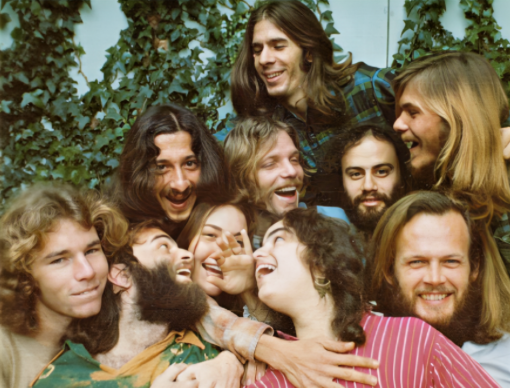
Underneath the San Francisco Fog
Riding the Muni train through San Francisco in the 1970s would run you about 25 cents. The San Francisco Municipal Railway, pulled by groaning cables and wheels in a trench under the concrete, squeaked along the ups and downs of the steep hills and knolls of the effervescent city. The Muni map was a fitting tri-colored black, yellow and magenta of psychedelic gaudiness with lines tapering off into the southwest of the city. Turning the map on its head gave the illusion of a blossoming flower with a long stem running through the center. The stem of the People’s Railway is called Market Street and the further southwest it chugged, the gayer, the weirder, the more long-haired-smiling people it swallowed and dumped into the heart of the city. The city center was an electromagnetic field of wah-wah guitar sounds and spacey reverb and the Muni’s wire conductors brought in nothing short of an upheaval, a cultural awakening. The words “Castro Street” were the only two you needed to know to drop-in on the low, slow and friendly city where the tympanums of Victorian houses broke the fleur du ciel in the evening fog. By 5pm the neighborhood was blanketed in a thick coat of white. The houses, no two of the same shade, with their intricate bargeboards, gingerbread trim, corbels and turrets and fish-scale shingles, smushed wall to wall in perfect rows and began to sing. The fog squeezed the evening air tight like a pressure cooker, and indeed something was building– the city was coming alive.
Bring the color Gold….
Bring the photos of personal saints
And gurus and heroes of the underground…
Bring children…
Flowers…
Flutes…
Drums…
Feathers…
Bands…
Beads…
Banners…
Flags…
Incense
Chimes…
Gongs
cymbals…
CASTRO– A red sign emblazoned with white lettering and wings adorning the top corners sat on the foot of a lumpy hill. The neighborhood teemed with creatives: descendants of the Beatniks, a post-WWII disillusioned people and the forefathers of a counterculture intent on changing the world. Bohemian Beatnik coffee houses that swelled in a whirlwind of words and the Scripture of Golden Eternity soon turned into bars with hippies reinventing themselves in the new ideology; expanding consciousness in the mind-altering hallucinations of LSD and experimental attitudes. The Oracle, an underground newspaper of the Haight-Ashbury, conveyed it as such: “It's like somebody lifted up a giant flat rock and we all crawled out at the same time.”
The ideas of free-love burst through the cracks of the Castro sidewalks. They spilled into posters of poetry and protest on light posts, conversations at the tips of glowing cigarettes and lazily rolled joints passing between fingers with dirt crusted nails, dipping through the hills of San Francisco, through intersections with hordes of skinny sneakers and shabby boots holding signs screaming “down with fascism”, where the answer to all problems was a mere matter of tuning into the “beatific vision”.
“Turn on, tune in, drop out.”
This was Tim Leary’s declaration of independence to the youth of San Francisco: an encouragement to go against the grain. In the streets, bushy faced men and scraggly acne boys met long haired loose girls in sweeping skirts. A youthful hubris pulsated through the neighborhood as people wandered into the unfamiliar. It was a trade of stability and convention for spiritual and sexual freedom. It was a time of religious invention and the absence of God; of settlements in communes and vagabond escapism. Of bars where people entered and danced for the next ten years. It was a place of drawn-out iconoclastic theoretical discussions in dusty rooms with used furniture where afterwards all participants took LSD and had sex. A search for deep, mindful connections and hazy fragments of interaction. It was an ideological oxymoron, an era of hypocrisy and contradiction. Maybe it was the liquid projection light shows, or maybe everyone’s brain was fried from the LSD. Maybe the folk-rock-bluegrass bands had discovered the secret for writing anthems of cultural revolution. But this was the era of overthrowing the American establishment. “It was a time where being young and American meant that you deserved the world.”
The Haight-Ashbury was a living stage, with coordinated anarchist street takeovers, summer solstice ceremonies and free rock concerts. It fed hundreds of people in the panhandle every day and helped provide crash pads for America’s young refugees. Boys in long dresses with tattered hems and girls in baggy pants and suspenders stood on street corners dancing to electric car sounds and the radios of passers-by. And almost overnight the Haight became an island–a separate entity of San Francisco with its own network of performance art, music, literature, charity, drugs, trade, newspapers, and customs. Meanwhile, families in the Castro moved to the peninsula, and in the newly working class neighborhood you could get a house with six rooms for $120 a month, bringing groups of young people together under one roof. These neighborhoods grew as a microcosm, independently from the rest of the city, unnoticed by “the establishment”, before sweeping an unsuspecting nation by storm. But not everyone was prepared to accept the unusual, unspoken, collective change.
People put the word “free” in front of everything. “Free boy”, “Free girl”, “Free love”. Families were no longer innate but created, and communal dinners around long tables with plates filled by food from the garden and the communal money jar was a kind of normal. Houses with big beds and light and music and crazy hippies who left their doors unlocked and threw away the key invited strangers to come through, many who arrived by foot after long periods of travel. After lazy afternoons rolling in and smoking grass at Dolores Park, they swam through the fog searching for home.
***
Maxime had heard about it from a towering Belgian named Luc Alexandre. He and his sister Catherine had taken the train from France to enter in a singing competition in Belgium where they met Luc, singer, actor, performer and lively bearded man. He told them all about la maison bleu, the blue house in San Francisco, and recounted life inside its walls. A place where rules did not exist, and people would want for nothing, and plans were loose (as were the women), and this liberty of living left a glow on his face that could make even the happiest of men a tad envious. Catherine and Maxime swapped mischievous grins. As burgeoning musicians who idolized the famous California folk artist Joan Baez, Maxime wanted nothing more badly than to play like her. After winning the competition, the Le Forestiers cashed their prize and scraped centimes until they had just enough money for two roundtrip tickets to the United States.
***
It was August of ‘71 and the days were warm and comfortable. A chilled wind blew softly from the west, raising goosebumps on the skin of linked arms brushing and bumping down the avenue. Maxime and Catherine lugged the few belongings they had up and down San Francisco to 3841 18th street in the Castro. Maxime loved that American cities had perpendicular streets– he could wander without ever getting lost.
There wasn’t much need for an address, you could pick Big Blue out of a lineup– it was exactly as Luc had described it. It had four stories. A long staircase snaked around the first floor garage, hooked right at the top, and gave way to a porch with white pillars that held up an awning surrounded by three bay windows. The lower levels were framed by a strip of gold leaf wooden bows strung like garland, and just above them, a smaller square window sat under the tip of the roof where the attic might be. Up the steps, deep breath. Maxime’s fist knocked on the sky blue wood and before he could think to change his mind or about what he should say to this group of strangers, the door whipped open and a contented smile under a pair of bleary, unfixed eyes appeared before them– a look of total unsurprise. “And who are these gorgeous tomatoes?” The man reached his hand out and rubbed their stomachs–a common greeting at Hunga Dunga. “Hunga Dunga” was the Marx Brothers’ Duck Soup-inspired name the inhabitants gave their commune. Catherine’s eyes grew wide as she stared at the hand on her stomach and a pool of bushy heads crowded the doorway. “Don’t freak them out, Richard,” Ellen laughed and tossed the glossy chestnut tresses over her shoulder with a flick of her head. “Come on in.”
The pool of people scattered and a sea of mismatched socks lined a path for the newcomers. The Le Forestiers would eventually come to find that mismatched socks were a Hunga Dunga trademark in the neighborhood. The house traditions followed that wanting for nothing meant detaching oneself from personal material belongings. Instead, they had closets labeled “coats” and drawers labeled “socks” that everyone would share, and all the other communes of the neighborhood would look down at their feet and say: “You’re from Hunga Dunga aren’t you?”
It only took a few words for the strange group to realize that the siblings were foreigners, and a frenzy of curiosity ensued. More people trickled down the stairs and emerged from behind closed doors and long hallways. A skinny man wearing an orange and gray flannel stepped forward. The man wasn’t notably attractive but nonetheless fair-looking, with kind eyes and a hairline so straight, it turned his forehead into a perfect rectangle. He possessed an intangible alluring quality and spoke with an ease of tongue, relaxed and practiced, as if he’d given the speech many times before, “This is Trudy, Nicky, Ellen, Richard, Lizzie, Ellen, Bobby, Tom, Larry, Baird…” it seemed like he had lost count, “well, everyone, minus a few. I’m Phil.”
A bellowing voice sprang from behind the socks, “Vous êtes venu!” You came! And in one swift motion Luc leapt forward and pulled Catherine and Maxime into a warm embrace. “Bienvenue à Hunga Dunga.”
Big Blue didn’t always go by Hunga Dunga, or even Big Blue for that matter. She may not have always been blue, or would always be blue, but it was part of her and without it, she was lost.
The first thing Big Blue remembers seeing is the pretty peach house across the street. It was 1904 and with careful craftsmanship and laborious handiwork that boasted an acute attention to detail, she stood proudly among the other Victorian and Edwardian houses that lined the cusp between today’s Castro and Mission districts. She was the ardent endeavor of an architect's dreams in a post Gold-Rush residential boom where builders, inspired by their own eclectic community, took their time and good fortune to construct row after row of ornate houses. Each house was unique, and each was equally beautiful as the next. Not long after, Big Blue felt the Earth shake. Her wooden joists creaked and screamed, horrified at her paralysis, as the people tumbled to their doom and the fires roared at scalding temperatures drowning the world in smoke. It was 1906 when many people succumbed to their death, victims of the San Andreas fault. She witnessed with a heavy heart, as the city was forced to pick up and rebuild itself once more. Young workers strapped on tool belts and balding businessmen in suits and hats crossed her path on the way to work. The gloom of passing days slowly lifted, the roads were re-paved, and the horse drawn carriages turned to cool steel machinery. In 1915 when the Castro Theater was finally finished, the new street lamps lit the pathways home, and Big Blue would fall peacefully asleep on a pillow of fog.
For the next 25 years the turbulent times returned. At first, people’s new-found love for luxury and decadence was more than appealing. Bluesy-jazzy notes erupted from the horns of record-players and increasingly crowded bars, and stumbling girls in short silver dresses and funny hats would whisper and giggle as they climbed back up the porch steps in the early morning. But this feeling died with the arrival of the Great Depression, and hardship caused such panic and loss that the late night music was replaced by the melancholic lullabies of crickets and distant car horns. Still, the heart of San Francisco culture continued beating softly. And when the Golden Gate was hoisted into the ocean, a rumble of tourists plowed through the streets and the semblance of joy had returned.
Big Blue noticed that the people of San Francisco were hard to understand and often difficult to please. World War II had made the city prosper, but the subsequent Vietnam War had made the people very angry. She had seen tragedy up close and from afar, but it wasn’t until the Beat Generation was born that she had learned the language of San Francisco, and the words floated to her from the open windows of nearby coffee houses. Just as she started to comprehend them, people began to leave. Families packed their cars from floor to ceiling with suitcases, boxes and screaming children, engines sputtering down the hills toward the peninsula, leaving Big Blue empty and alone.
***
His name was Phil Polizatto but he went by Giacco Giordano, or sometimes Chazan, or Jeremiah or The Unapologetic Hippie–that’s who he really was. And before he was a founder of Hunga Dunga, to some he was an acid dealer, for many a lover and an eager, enlightened conversationalist during the cigarette after sex or the joint before sex or in any instance completely unrelated to sex. (But something about these conversations somehow always led to sex). In the artists’ circles he was the guy who hung out with rockstars like Dean, John and Hilton from the Animals, or Frank Zappa, Ray Manzarek, or Lee Michael. To him they were just guys who liked music, drugs and good conversation. So he might make a delivery now and then riding up the paved slopes of Laurel Canyon, hands gripped white to the handles of his motorcycle, strapped with various forms of acid and interpretations of musical rhythm that would flow in his body and out his limbs when the music switched on. On paper, Phil was a Georgetown University graduate of the Foreign Service School and a society dropout. He took pride in his commitment to the hippie lifestyle– he wasn’t one of those phony guys who threw on jeans and got high on the weekends only to return to a 9-5 come Monday morning. Although later he’d come to find that those straddlers with one foot in each world were the bridge hippies needed to live out their dropout dreams. Still, few would believe that a path like his could take such a jolting deviation and veer so far off the course of success in conformity. But his thinking was simple: they’ve never experienced the effects of acid like I have. They haven’t had my life-altering revelations, plus they’re probably too straight-edged to understand The Bhagavad Gita, The Upanishads, or the Jainist principles of ahimsa and too shy when it comes to sex. But Phil used to be shy about sex and used to only get high on weekends. He was supposed to be a member of the diplomatic corps, but once it had begun, Phil could not deny this part of himself. So there he was, living in New York, working in a restaurant, dropping sugar cubes laced with 500mg of pure LSD 25 in the West Village after his shift, and hiding the truth from his family.
***
1970– It's a time those less than sixty years old will never know. San Francisco at this moment hung flowers just under the windowsills of humbly furnished nests hippies would soon call home, and in the Castro, “For Rent” signs swung back and forth in the changing winds. It was here where they met: Phil who cried out for a sense of purpose, and Big Blue who stood naked on her slope of the street, watching the waves of people at Dolores Park go to and fro. Phil had come to know a group of like-minded hippies who quickly became his family, and by some karmic fate had not only found one another, but together, settled in Big Blue, soon to be the center of gay heaven.
It was still unclear whether the mystical city drew the weirdos out from under rocks and called to them like trumpets and violins from the windows of Hendrix’s apartment, or if perhaps the city’s fantasy drove people to inhabit the purported myth. “The scene has grown up with us, we have grown up with the scene. We’ve grown up together,” claims the Grateful Dead. But before the insanity, and before the Castro was the gay pickup spot with restaurants, bars, leather shops, and art boutiques, Phil and the Hunga Dungans had only a hardware store, a grocery store and a movie theater. They were good friends to Harvey Milk and hung out at his camera shop. Big Blue was pleased to be their vessel, and the Hunga Dungans were building their dropout dreams, fueled by the belief that the success of their home proved their ideas could work for the masses. Friends told friends, who told friends of friends, who met strangers with friends, and the commune seemed to grow in number by the day– and it was never too much.
One morning Big Blue awoke to her neighbors who now too were crawling with other long-haired freaks that had checked out from the unpleasantries of the real world, and whose bohemian lifestyle choices exacted happiness and became the legacy of their lives. A constant flow of music and laughter gushed from the houses that had become the alembic of 60s counterculture. And the people who wanted for nothing created an impenetrable bubble where the definition of love often meant feeling good and making peace meant “come what may”, and all the while rejecting any pre-established social rules and capitalist conformity, whether wrong or right.
***
“Hey that smells good,” Phil started. Richard looked up momentarily from the numbers in his notebook to investigate Rosie, who leaned against the stove in the kitchen, admired by Nicky, and cooked up a smell close to barbecue chicken out of pasty-colored tofu. Everyone had roles in Hunga Dunga– they weren’t mandated by anything but tradition and sheer will. If someone didn’t want to do something, they never had to. Traditionally, Ellen was a good cook and didn't mind being the one to conjure many of the family meals–so long as people helped her with the dishes. Today, it was Rosie. Traditionally, Richard was good with numbers and happily handled the finances of the house’s joint bank account where everyone shared all the money they had. After the bills were paid, the rest was redistributed among everyone for personal use along with the various savings accounts.
The Hunga Dungans contributed the talents they possessed to the benefit of the community. Some were better than others at volunteering their time and skills, but there were no rules, and if one week all someone had to contribute to the group was the positive vibes they were emitting into the universe, then so be it. “Thinking is hard work too!” Psylvia would say about Nicky who was still a teenager and notoriously contributed less often than the rest. It was a line that several used on many occasions.
As the smells wafted through the staircase to the upper floors and the clock neared 5, Catherine Le Forestier and some others came out to help set the table for dinner. A long wooden table that couldn't fit more than 12 stretched from one end of the dining room to the other. When dinners grew to a larger size, which was not uncommon, they would lay straw mats onto the floor and sit on cushions of all different colors and sizes that had been collected and gathered around the food. Phil would scan the faces along their floor table and sigh with pleasure. Such squalor is heaven.
At this moment, Maxime paused his strumming and looked up from the corner of the room, watching them as he always did. Catherine was gabbing with Larry. The two had grown quite close over the course of their stay, but Catherine had made time for everyone. She tried to speak with all the people of the household one-on-one and get to know them. Her affection and interest was not something the Hunga Dungans initially sought out, but they grew to love Catherine as her selfless charm was not only irresistible but very much Hunga Dunga. Maxime on the other hand was a recluse. He kept mostly to himself, sitting always in the big chair in the corner. Like a sponge, he sucked in all the goings-on about him, participating very little but listening intently, only to scribble something into his notebook before looking back down at his fingers, strumming the same few chords incessantly. The Hunga Dungans didn’t care much for him but remained intrigued. He was so out of reach that oddly it made him more desirable, and under his shaggy mane of beard, most agreed he was rather attractive. At last everyone had arrived downstairs and people were starting to grab their plates and take their seats.
Dinner at Hunga Dunga was like Sunday mass for a Catholic. Not only would missing it result in hunger as communes this large bought ingredients, not snacks, but there was a kind of spiritual
starvation that came with denying oneself of the pleasure of Hunga Dunga’s company. The tradition of gathering at 5 o’clock for dinner had held every night for the last 8 years, and it was the most revered. It was here where the magic of Hunga Dunga took place: lively conversation, swapping wild stories of life and travel, unfiltered thoughts, uncontrollable howling, and drinking almost always followed by singing. It was the most communal aspect of their commune, and their whole raison d’etre.
This particular night at dinner Phil and the Hunga Dungans were telling stories of their beloved Psylvia who they hoped would come back soon. It was always a mystery to those on the outside how communes of so many people with so many differences stayed together. How could all problems be reconciled in a house of sometimes 20 people? But not every commune was Hunga Dunga, and it was no secret that everyone in the Castro admitted that of all the houses, Hunga Dunga was a commune’s model example. Phil described it as “one big fuckin’ experiment inside our laboratory called Big Blue. Ways to rid the self of jealousy, material attachments, greed, selfishness, prejudice, hubris.”
***
There was only ever one instance in which the house was divided. There existed two groups: The Dungas–who would wake up at 4 am for the food-buying trips, loading the van full of tons of food. It would take several trips, required long hours of heavy lifting, and it wasn’t fun. But at 9:30 am it was over. Then there were the Hungas. They slept in, had time for breakfast, and giggled and talked and meandered all day during their deliveries. They would take the second-hand Dodge step-van acquired from ‘the good dog guys’ at “Free Garage”, and drive to the 14 or so communes of the Castro neighborhood to deliver them food. This was the most fun because making deliveries meant talking and socializing with friends at the other communes, and it almost always involved taking pit stops at each house for the select, three, four, or hell sometimes all the Hungas for a quickie. The van, who they had named Juliet, would arrive at a Big Blue look-alike with its blossoming cornucopia of fruits and vegetables exploding from the side panels onto the hood, proudly painted on by Psylvia.You could always tell it was the right place because someone was usually visibly naked, strange decor would hang in the windows, and because of the sheer amount of people (and hair) that would spill out of the house with empty bags and boxes after a couple honks on Juliet’s horn. The Hungas would open the back doors of the van and some foldout wooden stairs with hand-carved banisters (courtesy of Nick) would stand at the foot of the finest grocery store in the Castro, lined with newly painted shelves and everything you could ever want to eat.
The weekly shopping list resembled something like this:
Crates of organic fruits and vegetables from the Farmer’s Market. Fifty-five gallon drums of olive and safflower oil direct from the processor. Forty-Pound bags of the best coffee beans from a tiny storefront in North Beach. Ten-gallon containers of freshly made tofu from a small company in Japantown. Gallons of unpasteurized milk and juices from the budding hippie enterprise in Santa Rosa. Grains of all kinds by the bushel from the distributor in the East Bay. Condiments by the box from a wholesaler in the Mission. Seasonings by the pound from a collective in Marin. Luxury items like papayas and mangoes we could only afford by the handfuls…
The Hungas and Dungas traded shifts weekly.
Some years before the arrival of the Le Forestiers, Lizzie called a house meeting to present the idea. “Eli from The Friends of Perfection approached me just the other day about Hunga Dunga’s lack of raison d’être…” the room was silent–waiting, “there’s a need in the community that methinks we could fill: the best food at the best price.” The Hunga Dungans looked at each other with puzzled glances in anticipation of the explanation of Lizzie’s passion project. The company was to be titled “Greenleaf” and he was so enthusiastic as he pitched the plan, that his words inspired several nods of appreciation at the attention to detail and its potential for success.
Greenleaf functioned like so: it had applied and been approved for a wholesale grocery business license to be allowed to legally collect food stamps, and did so from about 14 different communes in the neighborhood–no matter how much or little each one had. Richard would then announce, “I’m going to The Big Benefactor”, and turn in the stamps to banks in exchange for hard cash. Greenleaf used the cash to buy quality food at wholesale prices from markets, wholesale outlets, and local companies, and redistributed it to the communes. Normally, one gives food stamps to the grocery store in exchange for food and later the store cashes the stamps for real money, but Greenleaf switched the order of the transaction to achieve a better result for all involved communes. The best part was, no one ever paid a dollar. The ironic realization that Hunga Dunga’s greatest communal contribution to the Castro hippies’ dropout dreams was entirely dependent on the capitalist system was not lost on them. But the hippies had their own secret name for the project. They called it their “Free Food Conspiracy”.
Richard and Lizzie were an outright hit. Richard was the bookkeeper and accompanied Lizzie on all his trips. He called Lizzie “ma capitaine d’industrie” which Lizzie never understood until one day Catherine explained it to him. And Lizzie became so good at his job that after a while he wouldn’t only discover the vegetable or fruit deal of the day, or bargain for the best price on a bushel of brussel sprouts, but gained such impressive amounts of knowledge about prices and produce that eventually he began tracking global weather anomalies to make predictions about future crops, to which his friends would use to consult him on packing advice if ever they were leaving the country. Every time Richard, Lizzie and the Dungas went to the Farmer’s Market, he recalls, the sons of old Italian vendors would stick their bellies out and shout things in Italian, waiting for Richard’s rather original stomach-rub greeting.
***
Towards the end of their stay, the San Francisco days were just beginning to cool and November had approached faster than either of the siblings had anticipated. Four months had passed since the arrival of Maxime and Catherine, and it was apparent that no one in the house had any clue as to what kind of path the LeForestiers were on in their music career. While the siblings had come to see la maison bleu, and ultimately wanted to stay longer, they left to kick off a small music tour that had been arranged prior to their arrival. They were preparing to embark on a few months of travel as real musicians and fortunately, they had met just the right people beforehand, as most of the commune was well-traveled.
Hunga Dunga was accustomed to bidding adieu, and as Big Blue casted its long shadow onto the poorly lit street, Maxime and Catherine climbed into a taxi and rode away. Hunga Dunga stood on the porch under the awning where they had first arrived and waved farewell until not even the red taillights of the car could be seen.
In 1972, a year after Maxime and Catherine had gone, Hunga Dunga received something in the mail. It had been shipped all the way from France. Luc unraveled the packaging that had traveled across continents, unveiling a record. A picture of Maxime surrounded by greenery and a bright pink off-center flower adorned the cover. At the top in yellow letters read: Maxime LeForestier.
Phil and Luc looked at one another and shrugged. They put it in the bookcase and it began to gather dust.
Only months later Luc asked Phil if he wanted to listen to the album. Phil remembers having had some time and saw no reason to refuse this request. It was one of those off chance life changing events where no one in the moment understood just how significant their decision would be.
Luc pulled the record titled Mon frère from the shelf, dusted it off, and slipped the vinyl out of its casing. He placed it onto the record player and lifted the needle. With a soft crack the album began to spin and the two sat on the couch, listening. There was no denying Maxime’s lovely voice, but still–that guy was a slouch. When he came to visit last year he never vacuumed, or cooked or cleaned or helped with anything at all. He just sat in the corner like a lamp, strumming his guitar.
The record was almost finished when in the second to last song a lovely set of chords were struck. Phil picked up the paper casing of the record and traced the title of the song: San Francisco. He and Luc proceeded to be blown away.
First they listened, then Luc translated the lyrics word for word. They were beautiful. It was Hunga Dunga’s eternal time capsule:
“
It’s a Blue House
With its back to the cliffside
We come by foot , We don’t knock
Those who live here have thrown away the key
We find each other together, after many years of road
And we come sit around a meal
Everyone is here at 5 in the evening
When San Francisco fogs up
When San Francisco lights up
San Francisco
Where are you?
Lizzard and Luc, Psylvia
Wait for me…
“
What better way to say “thank you” than to write Hunga Dunga its very own love song, Phil thought. At this time, no one in Hunga Dunga realized that this song was making the record fly off the shelves in the singer’s native country.
***
Maxime did a television interview with France Bleue in 1973 after his song became a hit. It was one of many he was doing at the time–France was enamored with the story of the blue house on the hill.
“Can you tell me about the Blue House?”
“No. But I can show you.”
And Maxime, guitar in hand, began to sing the song that France had embraced and channeled as their vision of that peaceful hippie world, wondering what it was in the air that the fog brought down the hills which formed these disillusioned, happy people. His warm, dark eyes brimmed a white moon of light that reflected the strategically arranged spotlight behind the camera, but something deeper crawled out from behind and made them glimmer. He blinked tenderly in the reporter’s direction, gazing into her eyes with that kind of “I love you stranger” quality you get when you’ve been touched by the drunken youth of 60s San Franciscan freedom and nonconformity. And as he sang, he glanced to the side as if pulling the memories back out of his lyrics, then turned and stared directly back at the reporter, enveloping her into his world. He wasn’t sharing some long lost nostalgia but building it around them, sucking her into every word. And she traced his hopeful smile bearded in unkempt hair, haloed in his shaggy mane, up his button nose to the shimmer of wetness forming in the corner of his eye. At “wait for me” he cocked his head knowingly, as if to tell the reporter: she too understood what it had been like to be there.
Post a comment